torsdag 29 mars 2012

Under the skin pt 2.5 - blowing instruments

This is a smaller post, more of a side-note to the previous one on the speech aparatus. If you wanna read the first part on BRAINS and illusions of body ownership go here.
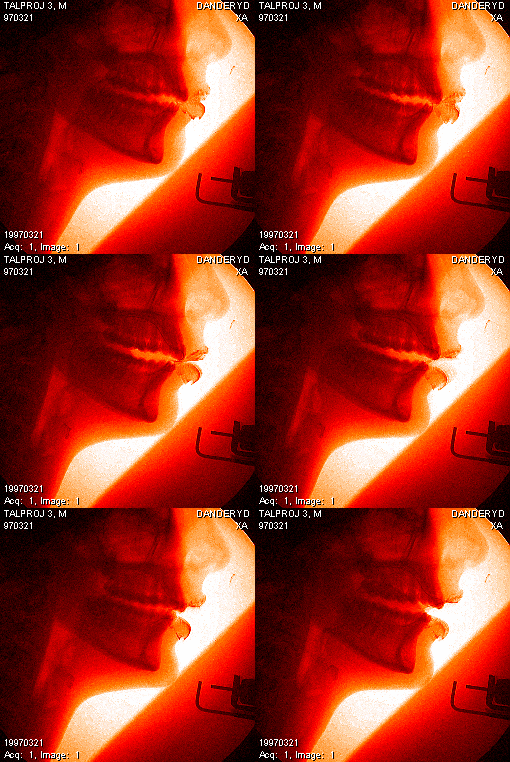
I was surfing around the internets looking for interesting x-rays when I found videos of people using their speech apparatus for other things than speech - blowing instruments! I just wanted to share them with you. Aren't they marvelous :)?


I think they're really interesting because they show the function that the pulmonic pressure (pressure from the lungs) and the shape of the lips play. Sometimes the note changes but we see no/little change in the upper parts of the vocal tract, and that's because of stuff going on further down or because of the lips.

Now let's enjoy some sweet sweet jazz.


And some "sexy" saxophone
(quite impressive what he can do lying down actually)

and why not the great meme of 'sax rolling' while were at it :)?

Bye bye!
P.s. Here's another great clip of x-ray blowing!

onsdag 28 mars 2012

Under the skin pt 2 - Speech apparatus

We continue to look under the skin. If you wanna see the previous post on BRAINS and illusions of body ownership go here. This post is about the speech apparatus and contains a short introduction to phonetic symbols. If you wanna see some x-rays of trumpet blowing go here.

"I want a doctor to take a picture so
I can look at you from inside aswell"

The Speech Apparatus

Female subject saying ''både'' (eng: both)
Pictures from Christine Ericsdotter's website
Female subject exploring her vocal tract
Pictures from Christine Ericsdotter's website
Male subject saying ''pion''[piun]
Pictures from Christine Ericsdotter's website
 These images are from Christine Ericsdotter's website, go there to learn more about the project! I believe they have been modified slightly to accentuate lines separating different "soft parts".

Christine Ericsdotter

Christine Ericsdotter was one of my teachers in my first years of linguistics. She was a wonderful teacher and I wish I could take courses with her again. She is a phonetician which means that she is interested in speech communication - aspects of production and perception of speech, how humans create and register different language sounds and speech.
 
The study behind the images above
Christine and many others from the phonetics section of the department of linguistics at Stockholm university have been involved in a study that took place at the Danderyd hospital. They did x-rays of people when the spoke. The aim was to learn more about dental and retroflexive stops (different types of consonants) and their variation in different vowel contexts.

The subjects were subjected to as little radiation as possible, all appropriate safety requirements were met. The radiation dose was smaller than that of a typical visit to the dentist.

She's uploaded a few pictures from this study on her website. I love looking at them, suddenly everything I've learned about the vocal tract becomes so much more concrete. Please read more about the project here.

The vocal tract

 When we articulate we make all kinds of complex movements with our vocal tracts. We do not only make use of the tongue, as you can see from the images above. We make use of the velum (the thing in the back that closes the passage to the nose in the third image above), the lips, the vocal folds (way low in the throat) and much more.

It is not an easy task to master all of these tiny little muscles and produce the right sounds, yet it takes us so little time to acquire! Wonders of the mind and body. Take a look at the images above again- they represent one word per picture. We do that everyday, all the time - and way faster than that. Isn't it fascinating?


The IPA
The International Phonetic Alphabet (IPA) is an attempt to represent the sounds we make. Those representations will always be averages, means and estimations. Each speaker has a distinct acoustic environment and will sound different. When we want to modify a sound to fit a sound in a certain language in greater detail there is an range of different small extra symbols we can add to further specify the sound.

The IPA is not a collection of arbitrary sounds, there is a system to it. If you studied the IPA-chart and learned the logic behind it it would make way more sense. Unfortunately teachers in most schools just give out a list of crazy symbols and poor explanations of how it all hangs together. This often results in a quite useless exercise to try and remember weird symbols and their pronunciation without a understanding of how sounds of languages work.

English alphabet ≠ IPA 
Please keep in mind that even though IPA uses latin script this does not mean that the symbols are pronounced the same way that the letters of the english, swedish, french, etc alpabeth. Never forget that!
For example:
<through> - [θɹu]
<kidney> - [ˈkɪdni]
<scruffy> - [ˈskɹʌ.fi]
<diving> -
[ˈdaɪvɪŋ]

Also, there is great variation between individuals and groups of individuals (dialects etc). A certain sound may be produced different by different speakers. A phonetic transcription aims to capture this in great detail. A phonological transcription does not represent this variation but uses one symbol (phoneme) to represent a group of sounds (phones) that are used in exactly the same context.
An example would be the many different ways of producing an "r"-sound in Swedish. In a phonetic transcription they would all be different but in a phonological they would be represented with the same symbol.

International Phonetic Alpabeth-guide in swedish
If you are Swedish and you wanna learn more about the International Phonetic Alphabet or just language and sounds in general, then I recommend this folder that I've created. It's a basic introduction to how sounds are treated in linguistics. There are a few minor mistakes in it, I'm sorry about that.


Vowel chart
The folder and the IPA-chart contains a vowel chart. The vowel chart is meant to be used as a representation of how phonetic symbols representing vowels relate to each other.
First of all: image the vowel chart as actually representing the vocal tract like this:
Vowel chart and it's relation to the vocal tract. Cred: Mikael Parkvall
The location of the phonetic symbols represents where the tongue is positioned. If you want to see examples of how place of articulation plays a role than watch these videos of trumpet blowing and pay attention to where the toungue is when the notes are produced.
Then we go on to place out some more characters on our little map like so:


The vowels are arranged in pairs, the right is pronounced with rounded lips and the left with unrounded lips.


One of the things Christine taught me
Christine taught me a little phrase in Swedish that can help one remember how the four front unrounded vowels and the four back rounded are pronounced: "vi ber fem man dra bort vårt bord"

See? Isn't it clever? I think it is terribly clever. 


Bye bye now,
See you around hottie!
References:
Ericsdotter, C. (1999): Modeling lingual coarticulation in coronal stops. Master Thesis in Phonetics, Department of Linguistics, Stockholm University & Deparment of Speech, Music and Hearing, Royal Institute of Technology, Stockholm, Spring 1999.

p.s. Om du är grundkursstudent i lingvistik och fann "vi ber fem man dra bort vårt bord" hjälpsamt kan jag också tipsa om en minnesregel för Hocketts 13 designdrag för naturligt mänskligt talat språk: GRÅTT TUSS SUPA.
  • Godtycklighet
  • Röst-hörsel-kanal
  • Åtskildhet (aka diskrethet)
  • Tvånivåsystem
  • Traditionell överföring
  • Total återkoppling
  • Utväxlingsbarhet
  • Semanticitet
  • Specialisering
  • Snabbt avtagande
  • Utsänd överföring med lokaliserad mottagning
  • Produktivitet
  • Avlägensenhet (displacement)
Jupp, jag ska bli seriös lingvist jag :)!

Under the skin pt 1 - BRAAIINS!

"I want a doctor to take a picture so I can look at you from inside aswell"

- The Vapors - Turning Japanese

I wanted to share some awesome pictures on what goes on under our skin. I find it fascinating to see what goes on inside of us! I am one of those who has "really looked at my hands" as they say - I find the fact that we all have skeletons inside us and that it is mostly dark inside us amazing.

Imagine, inside your tummy right now there's no light - or at least almost no light. Your intestines are working away, squeezing and pushing and juicing - all in darkness. Same goes for your heart, pumping tirelessly away in darkness. It's only when a surgeon puts a light in you or open you up that they will see the light. We are all dark inside, literally. (Except for Xorn who has a star for a brain.)

Brains - Valeria Petkova

Hedvigs brain
Sebastians brain
These are our brains, mine is the top and Sebastians the lower. The pictures were taken in a fMRI (functional magnetic resonance imaging) machine (->). 


Difference between brains
As you can see there is a difference between the brains of myself and Sebastian. This is probably mostly due to where the "slice is cut" so to speak. The difference in size and location of the cerebellum (the thing that looks like a cauliflower in the lower back) is probably not only due to slicing, that's just the way our brains are.


Our understanding of the brain
The brain is an amazing organ and we don't really understand it. In popular science and news reports scientists are often portrayed as knowing exactly what parts do what and that isn't really true. They have some fairly good estimations about where things mostly occur, but not much exact knowledge.
But one thing seems to be clear: the size of the brain has nothing to do with intelligence - it is rather how we connect and use the neurons that matters.
In our first years we lose up to half of our neural connections. We do away with synapses that we have no need for and this is a good thing - we need to be effective not large. Our brain goes through very drastic changes and we all seem to end up with slightly different strategies and solutions for doing the same tasks.

If you wanna look more at the brain and its parts visit "The Secret Life Of The Brain".

Why we have these pictures
We participated in an fMRI-experiment at the Karolinska institute in the fall of 2009. It was a part of my friend Valerias dissertation. I didn't know her at the time. I just saw posters at the university where they were looking for subjects for a study of "out of the body experiences". We thought it sounded pretty sweet so we signed up. Scientists in the making as we are we couldn't refuse to be part of such an epic study.

When the experiment was over they sent us a jpg-image of our brain. To be honest, we did get a sum of money too but I would have done it for the picture alone. I'm very happy to have it.

She met my good friend Gerard later and they became a couple. That's how I got to know her, months after she had done the experiment on me. They are two of the sharpest and nicest people I know. The world of interesting, sensible and nice people seems to be quite small.


Valerias study - making someone believe they are a doll
Her work is very interesting and concerns how we can perceive things as a part of our body even though they clearly aren't (perceptual and neural underpinnings of body ownership). They were trying to fool our brains with illusions that made it seem that a plastic doll was our body. If you're interested then read samples from the three articles they published.

Rubber Hand Illusion.
Picture from
The EmotionMachin-blog
Body ownership illusions
The classical example of this is the Rubber Hand Illusion, see youtube vid here.
The basic idea of body ownership illusions is to present the subject with a fake body part and let them see it being poked at the same time as the actual body part, that is out of sight, is being poked. The brain might (this doesn't work on everybody) assume that the fake body part belongs to the body because of the connection between seeing it being poked and the sensation of being poked at the same place.
My summary won't do this justice by far, I apologize Valeria!

What is so amazing with Valeria et als studies is that it's not just the hand but the entire body (minus the head) that is being faked. Quite awesome.

(At her phd defence she was asked if this could help cure racism, experiencing someone else's body as one's own :).)

The Ehrsson lab has the statement How do we recognise that limbs are a part of our body, and why do we feel that our self is located in the body. I means the epicosity of that statement is over 9 000!!

It's the same lab that was in Swedish news about fooling people that they had legs the size of barbie's legs. See youtube-vide here(!).

I hope you enjoyed looking
under the skin with me ^^!
I enjoyed spending this time with you,
see you around my little lemondrops.

"Turning japanese
I think I'm turning japanese
I really think so... "
References:
Petkova, V.I., Björnsdotter M., Gentile G., Jonsson T., Li T.Q., & Ehrsson H.H. From part to whole-body ownership in the multisensory brain. Current Biology(2011) 21 1-5. PDF

Petkova, V.I. Ehrsson, H.H. If I were you: perceptual illusion of body swapping. PLoS One (2008), 3(12):e3832, Epub 2008 Dec 3 PDF

Petkova, V.I., & Ehrsson, H. H. Body self-perception. McGraw-Hill 2010 Yearbook of Science & Technology, McGraw-Hill Professional, New York (2010), 50-53 PDF

Petkova V.I., Khoshnevis, M. and Ehrsson, H.H., The perspective matters! Multisensory integration in ego-centric reference frames determines full body ownership. Front. Psychology (2011), 2:35 PDF

söndag 25 mars 2012

Creativity block

When I feel clogged up and unable to produce anything, I watch these videos and they make everything better.

Maureen Johnson "Dare to suck!
- extremely good advice from a professional novelist

Kirby's Everything is a remix, part 3 "The Myth of Creativity"
- extremely informed advice for very good filmmaker

Gwen Stefani "What are you waiting for?"
- extremly hot advice from awesome queen of skatepunk
See also: Copying is how we learn

söndag 18 mars 2012

By the river, third time

The ice on the Red River has almost completely melted. At least by the bend close to our house.
I was down by the river last tuesday and this video is from Saturday (St Patricks day) and the difference is huge.
Little things I care about, I understand if you don't.

fredag 16 mars 2012

En serie om tvång, feminism, identitet och min generation

Jag märker att jag ofta stöter på samma föreställningar om vad feminism är, vad förtryckande strukturer är samt vad det innebär för vår identitet. Istället för att upprepa mig om och om igen i samma debatter bestämde jag mig för att författa en serie blogginlägg här om tvång, feminism och identitet.


Syftet är att komma lite närmare förståelse, för just nu ger dessa debatter mig ingenting för vi missförstår varandra på så grundläggande punkter. Syftet ä också att försöka ta ner debatten några pinnhål och motverka att alltid tas som en attack mot ens person (se del 6 & 8).


Del 1 - problematiserar att folk använder tvång för att mena väldigt olika saker
Del 2 - handlar om varför tvång är en dum strategi och hur dagens feminism inte är densamma som 70-talets
 Del 3 - problematiserar vidare vad vi menar med tvång och ifall det verkligen är det feminister hålller på med
Del 4 - handlar om ifall det som är avgörande för tvång är dömandet, och i så fall: tvingar Dr Phil oss?
Del 5 - ställer frågan vad är dessa biologiska skillnader och vad har de egentligen för betydelse för samhället
Del 6 - handlar om att vi inte kan separera socialiserad identitet från "riktigt" identitet
Del 7 - handlar om att barnuppfostran aldrig är netural
Del 8 - handlar om varför feminism inte bara handlar om kvinnor
Del 9 - handlar om vi som inte alltid orkar bry oss om vår könstillhörighet
Del 10 - Ställer frågan: varför är det viktigare att diskutera kromosoner än strukturer som bevisligen orsakar men för livet?
Del 11 - En förlorad generation som knappt bryr sig

Slutkläm
Jag vet att alla människor inte är snälla. Men jag antar det. För det gör mig glad och mitt liv bättre. Jag väljer att tro att folk är vettiga och snälla tills de bortom all tvivel bevisat motsatsen. Det kanske inte stämmer med vetenskapliga belägg, men min världsåskådning handlar inte om vetenskap utan om känslor. Det handlar om att jag väljer det som jag tror ger bäst konsekvenser för min och andras lycka. 

När debatter rasar över om könsroller är biologiskt grundade eller ej vill jag gärna stanna och ställa frågan: om det var det, skulle den inställningen ge oss en bättre värld?

Tvång, feminism och identitet: del 11 (En förlorad generation)

Jag tittar inte på teve, jag äger ingen teve. Jag tittar inte ens på svt play. Jag har ingen dagstidning, slutade prenumerera när jag insåg att jag inte läste, det blev för mycket att bära till pappersåtervinningen.

När jag väl läser något som rör politiska debatter blir jag oftast förvirrad, för det känns som om debatten förs mellan väldigt gamla positioner som inte flyttat sig på 40 år och som inte längre är relevanta för mig idag alls.

Oljan håller på och ta slut, folk mår dåligt över att de inte kan uppfylla reklamdrömmarna, det flyger förarläsa missilbestyckade plan över civilbefolkning i pakistan.  Det går en obehagligt högerextremistisk våg genom europa, St Petersburg är på väg att förbjuda tal om homosexualitet, polen instiftar ännu strängare abortlagar. Klimatet i den europeiska politiska debatten skrämmer mig något oerhört. Jag upplever hur vi inte behandlas lika oberoende av kön, etnicitet, sexualitet osv.

Och vad handlar debatterna om i svensk media? Ifall det är rätt eller fel att Thorsten Flink tar Ana-gina på rumpan? Hur kan det ens vara ett debattämne, det är väl klart att hans fingrar inte har där att göra?

Många är helt pessimistiska och bryr sig inte om resten av samhället alls. Jag har träffat personer både i sverige, danmark, kanada, usa och andra länder som inte ens vet att de lever i en parlamentarisk demokrati. De röstar ibland inte ens och de orkar inte sätta sig in.

De känner inte att politiken handlar om dem. Vissa röstar inte ens. Alla partier i sverige förlorar medlemmar. Folk engagerar sig inte längre politiskt på samma sätt. De orkar ofta inte bry sig, de behandlar politiker på samma sätt som de behandlar medlemsvärvare för Green Peace  - jobbiga personer som tar upp dyrbar tid.

Många tillbringar mycket tid åt verklighetsflykt. Tomma timmar framför lolcats och failblog, Project Runway och True Blood, Skyrim och webcomics. Där kan vi engagera oss, där känns något viktigt.

Jag känner inte att politiken handlar om mig. Jag känner ingen anknytning till det som försiggår på debattsidorna. Jag är tyvärr ganska representativ för min generation.

Tänk på det. Ni förlorar oss.